

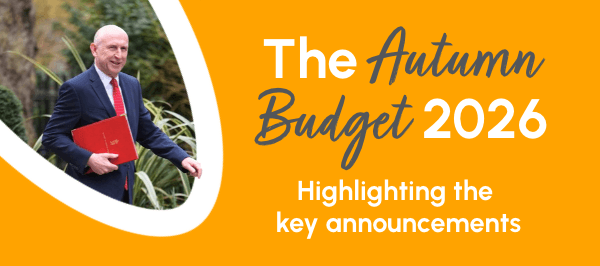
Going into the Autumn Budget, the Government faced mounting pressure to address the rising cost of living, support British businesses and demonstrate that its plans for economic growth were beginning to deliver results.
Taking to the dispatch box on 28 October, Chancellor John Healey presented his first Budget under the headline “Breathing space for today, hope for the future”, promising immediate support for households and businesses alongside longer-term measures to encourage investment and economic growth.
Against a backdrop of continued global uncertainty, rising energy prices and pressure on household finances, the Chancellor avoided widespread increases to the main rates of Income Tax, National Insurance and VAT.
However, behind the headline announcements were several significant changes to business taxation, Capital Gains Tax, investment allowances and the taxation of property and savings income.
Among the measures were additional support for high-street businesses, an increase in the National Living Wage, new incentives for entrepreneurs and changes that could have significant implications for individuals considering selling their business or passing wealth to future generations.
Whilst some businesses and individuals may welcome the financial relief, others will be looking closely at the announcements to understand whether the measures genuinely provide the breathing space promised.
As ever, the true impact of the Budget will depend on individual circumstances, with some announcements offering immediate support and others introducing changes that could affect financial planning for years to come.
- Business rates and relief
- Employment costs and wages
- Changes to personal taxation
- Support for entrepreneurs
- Business investment and growth
- Preparing for the future
Business rates and relief
One of the key announcements within the Autumn Budget was additional support for businesses operating on Britain’s high streets.
The Chancellor confirmed a package of measures designed to ease the financial burden on retail, hospitality and leisure businesses, many of which have faced sustained pressure from rising operating costs.
From April 2027, the Small Business Rates Relief threshold for eligible retail, hospitality and leisure properties in England will increase from £12,000 to £18,000 of rateable value for full relief.
The upper threshold for tapered relief will also increase from £15,000 to £21,000.
According to the Government, these changes will remove approximately 70,000 additional businesses from paying business rates altogether, meaning around half of retail, hospitality and leisure properties will pay no business rates.
The Chancellor also announced a two-year real-terms freeze in business rates bills for qualifying properties in these sectors, alongside additional relief for pubs, social clubs and most live music venues.
For smaller independent businesses, particularly those operating in market towns and rural communities, the measures could provide welcome financial relief.
However, business rates represent just one element of the overall cost of running a business.
Wages, insurance, energy bills and other operating expenses continue to place pressure on profitability, meaning that any savings will need to be considered alongside wider business expenditure.
The Government has also announced further support for energy-intensive businesses through the British Industrial Competitiveness Scheme.
From April 2027, more than 10,000 eligible businesses are expected to benefit from reductions of up to 25 per cent in electricity costs.
Whilst these measures may help certain sectors, businesses should review their eligibility carefully to understand what assistance may be available.
Employment costs and wages
Employment costs remain a significant consideration for businesses, particularly those operating in labour-intensive sectors.
The Chancellor confirmed that the National Living Wage will increase by 3.9 per cent to £13.21 per hour from 1 April 2027.
According to the Government, this represents an increase of approximately £910 in gross annual earnings for a full-time employee receiving the National Living Wage.
The National Minimum Wage will also increase to £11.27 per hour for 18 to 20-year-olds, whilst the rate for 16 to 17-year-olds and eligible apprentices will rise to £8.31.
For employees, these increases may provide welcome assistance with rising household costs.
However, for employers, particularly SMEs with larger workforces, they represent additional payroll expenditure that will need to be carefully managed.
The implications may also extend beyond employees receiving the minimum wage.
Businesses could face additional pressure to maintain pay differences between employees at different levels of responsibility, potentially increasing wage costs across their workforce.
Employer National Insurance contributions, workplace pension contributions and holiday pay may also increase as a result of higher salaries.
For businesses operating on relatively small profit margins, these additional costs could influence recruitment decisions, pricing structures and future investment.
The Budget also included changes to tax-free mileage allowances.
The Government has confirmed that employees and self-employed individuals using their own cars or vans for business purposes will benefit from an increase in the approved mileage rates to 55p per mile for the first 10,000 miles and 35p per mile thereafter.
For businesses with employees who regularly travel for work, the revised allowances may provide an opportunity to review existing mileage reimbursement policies.
Another announcement concerns parental pay, with the Government planning to extend support to additional parents, including self-employed fathers and partners, from April 2029.
With several employment-related changes approaching, businesses should consider reviewing their payroll forecasts and staffing budgets ahead of April 2027.
Changes to personal taxation
Whilst the Chancellor avoided increasing the main rates of Income Tax on earnings, several changes could result in higher tax liabilities for individuals receiving income from savings and property.
From 6 April 2027, the Government will increase tax rates on savings and property income by a further two percentage points, in addition to changes previously announced.
This means the new rates for property and savings income will be 24 per cent for basic-rate taxpayers, 44 per cent for higher-rate taxpayers and 49 per cent for additional-rate taxpayers.
For landlords and individuals receiving substantial taxable interest from savings, these changes could have a noticeable impact on their annual tax liabilities.
For example, a higher-rate landlord receiving £20,000 in taxable rental profits could face a tax liability of £8,800 under the new 44 per cent rate, compared with £8,000 at the existing 40 per cent rate, assuming the entire amount is taxed at those rates.
This represents an additional £800 in tax.
The Government has indicated that approximately 84 per cent of Income Tax payers will remain unaffected by the changes.
Nevertheless, individuals with larger property portfolios or significant savings income may wish to review their financial arrangements ahead of the new rules taking effect.
The Chancellor also confirmed that the annual ISA allowance will remain at £20,000, whilst announcing a new First Time Buyer ISA designed to support individuals saving towards their first home.
The Lifetime ISA withdrawal charge has also been reduced to 20 per cent, providing greater flexibility for certain first-time buyers.
Elsewhere, although the Budget did not announce widespread changes to inheritance tax rates or the main reliefs, several measures affecting pensions and estate planning remain important considerations.
From 6 April 2027, most unused pension funds and certain pension death benefits are due to be brought within the scope of inheritance tax.
This change was previously announced but is now approaching implementation, potentially affecting individuals who have historically viewed pensions as a tax-efficient way of passing wealth to future generations.
For some families, the inclusion of pension funds within the inheritance tax calculation could increase the value of their taxable estate and result in additional liabilities.
The Budget also introduced technical changes affecting certain trust arrangements and pension death benefits.
In addition, the Government announced a new Pension Tax Allowance from April 2027, intended to ensure that pensioners whose total income does not exceed the value of the new State Pension do not pay Income Tax.
For business owners, farmers and individuals with significant assets, succession planning may also require careful consideration alongside previously announced changes to Agricultural Property Relief and Business Property Relief.
With several important tax changes approaching, individuals may benefit from reviewing their wills, pension arrangements and wider inheritance tax planning to ensure their financial intentions remain achievable.
Support for entrepreneurs
Encouraging entrepreneurship and business growth formed another important part of the Chancellor’s announcements.
However, whilst the Government introduced new incentives for certain business founders, it also announced changes that could increase the tax liabilities of individuals selling established businesses.
One of the most significant measures was a reduction in the lifetime limit for Business Asset Disposal Relief (BADR).
BADR allows qualifying individuals to benefit from a reduced rate of Capital Gains Tax when disposing of certain business assets, including shares in a trading company.
The Chancellor confirmed that the lifetime limit for qualifying gains will fall from £1 million to £500,000 for disposals made on or after 6 April 2027.
The reduced Capital Gains Tax rate of 18 per cent will remain unchanged, but the lower lifetime limit means individuals selling businesses with larger qualifying gains could face a higher overall tax liability.
For example, assuming an individual has their full lifetime allowance available, a qualifying gain of £1 million would currently result in a Capital Gains Tax liability of £180,000.
Under the new limit, the same gain could result in a liability of £210,000, assuming the excess is taxed at 24 per cent.
This represents an additional £30,000 in tax.
Whilst the Government estimates that three-quarters of BADR claimants will remain unaffected, the change could have significant implications for entrepreneurs and family business owners considering retirement, succession or the sale of their company.
However, the Chancellor also announced a new Founders Relief, aimed at supporting individuals who establish and grow innovative businesses within the UK.
From 6 April 2027, the proposed relief will offer a reduced Capital Gains Tax rate of 10 per cent on up to £10 million of lifetime gains for qualifying founders of high-growth, innovative companies.
The Government hopes this will encourage entrepreneurs to establish and grow their businesses in the UK, whilst providing an incentive to reinvest in future ventures.
However, the detailed eligibility requirements remain subject to consultation, meaning not all business owners will necessarily qualify.
Another significant announcement concerns the taxation of company distributions.
From April 2028, the Government intends to reform the treatment of certain company distributions to ensure that similar transactions receive consistent tax treatment, regardless of their legal structure.
The proposals could affect company reorganisations, share buy-backs and business succession arrangements, although the Government has indicated that capital treatment should remain available for genuine changes in ownership.
The Chancellor also announced that the trading allowance will increase from £1,000 to £3,000 from April 2027.
This change is designed to support individuals starting a business or generating additional trading income, potentially simplifying tax arrangements for some smaller traders.
For business owners considering a future sale, restructuring or succession, these announcements highlight the importance of reviewing their plans well in advance.
Business investment and growth
Beyond the immediate tax announcements, the Chancellor placed considerable emphasis on encouraging investment and improving the UK’s long-term economic prospects.
The Government confirmed that the main rate of Corporation Tax will remain capped at 25 per cent, whilst maintaining the existing full expensing regime for qualifying business investment.
However, changes to capital allowances could affect businesses planning to purchase equipment or invest in new assets.
From 1 January 2027, the main-rate first-year allowance will increase from 40 per cent to 50 per cent.
At the same time, the main-rate writing-down allowance will decrease from 14 per cent to 12 per cent from April 2027.
These changes mean that businesses may be able to claim more tax relief immediately on certain qualifying investments, whilst receiving less relief in subsequent years.
For businesses considering significant capital expenditure, the timing and nature of investment could therefore influence the amount and timing of tax relief available.
The Chancellor also announced further support for growing companies through improvements to venture capital schemes, Research and Development (R&D) tax reliefs and employee share ownership arrangements.
From April 2027, the Government intends to remove the R&D claim notification requirement, simplifying the administrative process for businesses seeking qualifying relief.
Changes to employee share schemes are also designed to make it easier for expanding businesses to attract and retain skilled employees.
Beyond taxation, the Budget included an additional £20.4 billion in capital for the National Wealth Fund and British Business Bank.
This investment is intended to improve access to finance, support business expansion and encourage investment across a range of industries.
Technology and artificial intelligence also featured prominently, with the Government announcing a £700 million package to support AI development, security and adoption.
For businesses exploring automation and digital transformation, the continued focus on technology may create opportunities to improve efficiency, reduce administrative costs and develop new services.
The Budget also included measures aimed at reducing everyday operating costs.
The existing 5p reduction in fuel duty will continue for a further six months, whilst the planned inflation-linked increase has been deferred until 1 July 2027.
For businesses reliant on transportation, deliveries or vehicle fleets, the extension may provide some short-term relief.
Agricultural businesses may also benefit from reductions in tariffs on fertiliser and kerosene, although wider market conditions and operating costs will continue to influence profitability.
Whilst investment incentives and access to finance may provide opportunities, businesses will still need to consider whether new expenditure is commercially viable and aligned with their longer-term objectives.
Preparing for the future
The Autumn Budget has introduced a mixture of short-term financial support, targeted tax increases and longer-term investment commitments.
For some businesses, particularly those benefiting from business rates relief or new investment incentives, the announcements may provide welcome opportunities.
For others, the reduction in Business Asset Disposal Relief, increasing employment costs and changes to taxation could create additional financial pressures that will need to be carefully managed.
The wider economic outlook also remains uncertain.
According to the economic forecasts reported alongside the Budget, UK growth is expected to slow to 1.0 per cent in 2027, whilst inflation is forecast to remain above the Bank of England’s target in the near term.
These conditions could continue to influence business confidence, investment decisions and the ability of companies to manage rising costs.
Beyond the immediate announcements, businesses and individuals will also need to prepare for changes to HMRC’s tax administration and compliance requirements.
From April 2029, the Government intends to introduce more regular payments on account for individuals who already make payments towards their Self Assessment liabilities.
Whilst the overall tax liability may remain unchanged, the revised payment arrangements could affect cash flow for self-employed individuals and those with fluctuating income.
The Government also intends to introduce new direct debit requirements for VAT and PAYE liabilities from April 2029.
Mandatory VAT e-invoicing is also planned from April 2029, forming part of the Government’s wider efforts to modernise tax administration and improve financial reporting.
These measures sit alongside continued investment in HMRC compliance activity, including additional resources to identify errors, tackle non-compliance and improve tax collection.
For businesses, the move towards more digital and automated tax reporting is becoming increasingly clear.
Ensuring that accounting systems, records and internal processes are up to date will become increasingly important as these changes approach.
Whilst the Chancellor has presented the Budget as an opportunity to provide breathing space today and build confidence for the future, the practical impact will vary considerably between individuals and businesses.
Business owners considering a future sale may need to review the timing and structure of their plans, whilst employers should consider the effect of rising payroll costs on profitability.
Similarly, landlords, individuals with significant savings and those with substantial pension funds or family wealth may benefit from reviewing their financial arrangements ahead of the proposed changes.
That is why having a clear understanding of your financial position and the potential implications of upcoming legislation remains essential.
At Thorne Widgery, we will continue to review the announcements and supporting guidance to help our clients understand how the Autumn Budget may affect them.
If you have any questions about the changes or would like to discuss your financial or business plans, please contact your usual Thorne Widgery adviser.
To read the Government’s full Budget announcement, please click here.